> For the complete documentation index, see [llms.txt](https://documentation.panomics.bio/documentation/llms.txt). Markdown versions of documentation pages are available by appending `.md` to page URLs; this page is available as [Markdown](https://documentation.panomics.bio/documentation/access-control/ui/direct.md).
# Direct permissions
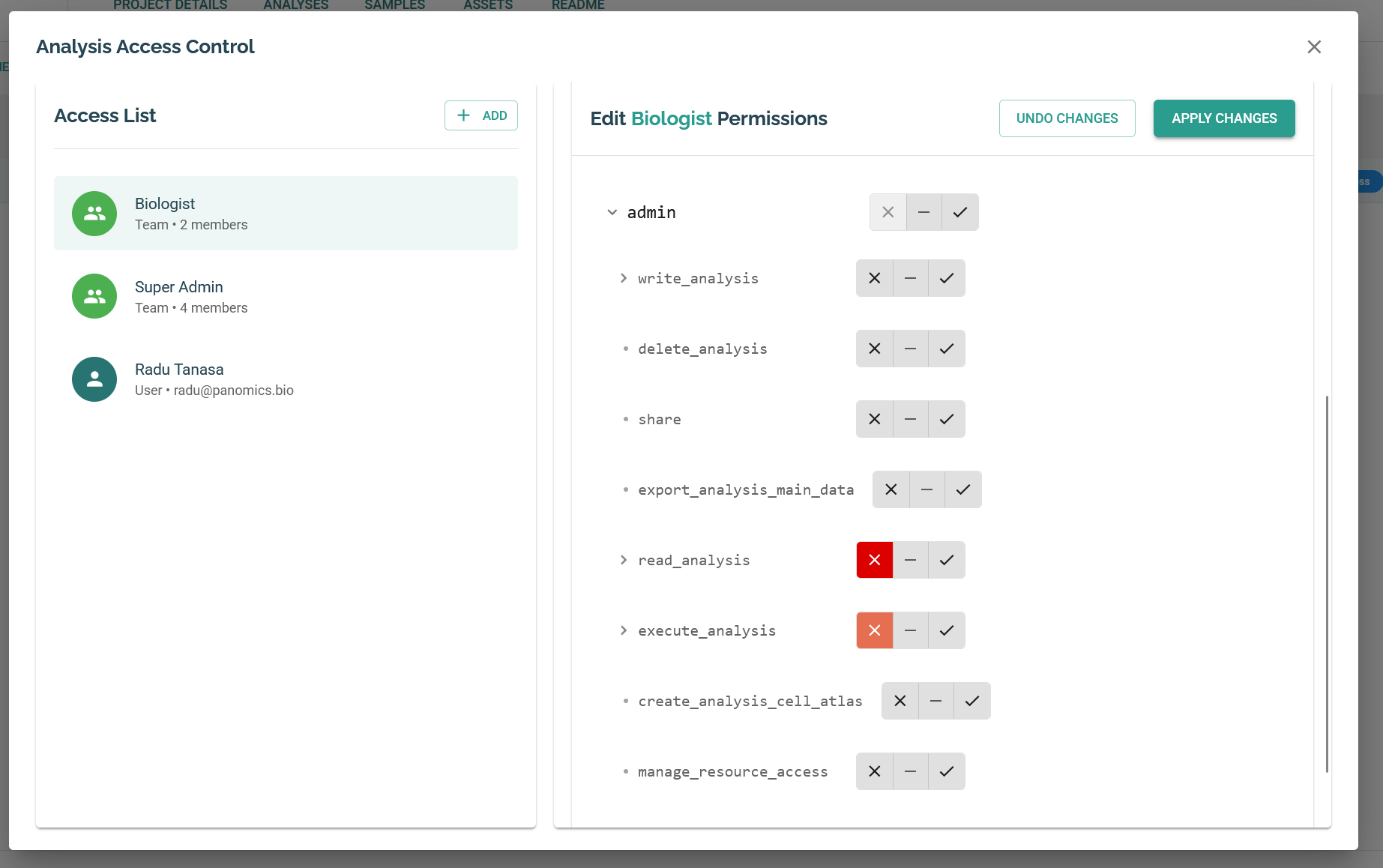
These are permissions granted directly to this resource and that are relevant to this resource. These are edited exactly how you would expect.
## Permission states
Permission States
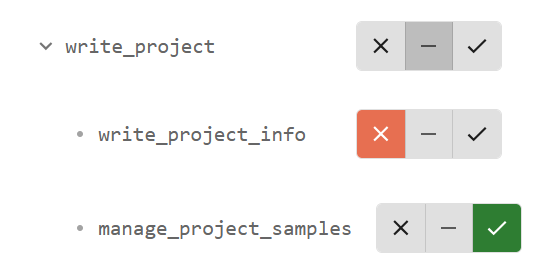
* **Allow (✔)** - grants the permission
* **Neutral (•)** - does not influence the permission. The principal either inherits it and it applies, or it does not
* **Deny (✖)** - denies the permission even if it's inherited. In Panomics, denies overturn allows
## Example use case
A team T could be granted read permissions for all analyses inside Project A. You can create a specific analysis as part of Project A, but grant team T "deny" for those read permissions. Now when team members from T navigate to the list of analyses in Project A, they cannot see your specific analysis.
{% hint style="info" %}
**Example - Hiding a sensitive analysis:** A team inherits read access to all Analyses in a Project. On one Analysis, set **Deny (✖)** on `read_analysis_*` to hide it from that team.
{% endhint %}
{% hint style="info" %}
**`admin` implies all actions** on this resource and its children.
{% endhint %}